A Diary of a Writer (1873)
A Diary of a Writer is a publication Dostoevsky put out in journal-form every month or so off and on during the last decade of his life. It contains mish-mash of short stories, reviews, essays, reports, sketches, memoirs, and. . . well, one can’t be exhaustive in trying to categorize such a genre-bending work. To better feature the gems I unearthed while reading the 1873 output, I’ve structured this blog in interview form. Dostoevsky’s words in this interview are my paraphrases of his ideas combined with quotes from the Kenneth Latz translation.
Dostoevsky and Writing. You once referred to yourself as “a realist in the higher sense.” What separates the different senses of realism from each other?
Fyodor Dostoevsky. Realism in the lower sense is art that slavishly imitates reality. This sort of art strives to be a mirror, a mimic, nothing more. This artist keeps a notebook and walks around eavesdropping on people, jotting down their characteristic phrases. Then, when he writes a character of a certain type, say, a priest, this writer simply whips out his notes about the common phrases priests use, and then mechanically transfers them to the character.
DAW. Why is this lower realism? Shouldn’t realism strive to reflect reality?
FD. Yes, but this approach has problems. The lower realist works under a constant fear that he might accidentally idealize his characters. But this commitment to the ordinary becomes a prejudice through which this artist squeezes all his observations.
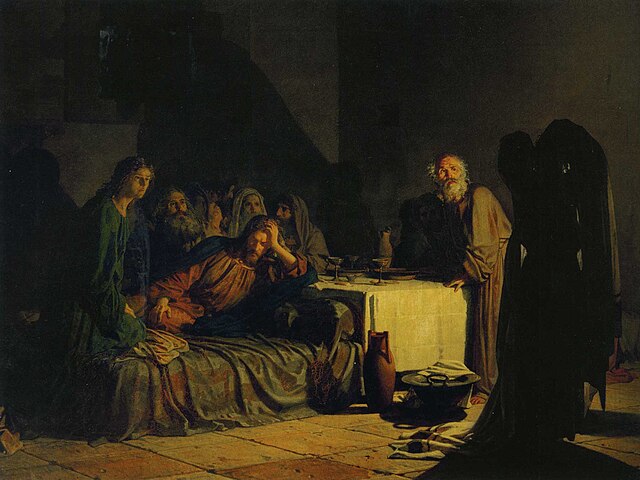
So, when dealing with colossal subject matter, as in Nikolai Ge’s The Last Supper, Ge, in order to keep to his so-called realism, must render this scene as an ordinary quarrel between ordinary people. This makes the moment incoherent—how could the movement of eighteen centuries of Christianity be connected to such an event? Nothing is explained in this painting. It is completely out of scale with the future. So these “realists,” with their fixation on immediacy, their avoidance of the ideal, end up forcing themselves to lie.
DAW. Then what’s higher realism?
FD. Higher realism can be seen in the work of a good portrait artist. Why does this painter like to have his subject sit for him? Because people don’t always look like themselves. The portraitist wants his subject to sit because he’s waiting for the moment when the subject is most himself. The portraitist’s gift is to seek out and capture that moment. In other words, the higher realist is hunting for the ideal. This ideal isn’t at odds with reality. The ideal is the import of a moment, thus it captures its historic reality and anticipates the future. This ideal can be seen in Christ’s face in Titian’s Render unto Caesar:

DAW. What does this look like in your writing?
FD. It effects my observations. I love to walk around Petersburg and watch strangers. But I don’t stop with merely looking. I follow my observation with questions. Who are these people? How do they live? What do they work at? What’s on their minds at this moment? And then I imagine possibilities. A writer can’t get to anything true by merely making observations. We have to explore the implications of the facts with imaginative guesswork.
And then when I write, my goal isn’t to replicate random bits of life by scrupulously describing actual events, but draw out the general idea across a broad range of similar phenomena. I did this in my novel, Demons. The book is based on an historical event, but my goal wasn’t to reproduce the event in its particulars, but to explain how such an event could arise in our society. I had no interest in reporting on an historic personality, but rather I sought to show how our society could make possible that personality and make possible that he should have followers.
DAW. What advice do you have for writers who wish to follow your way of higher realism?
FD. The bulk of writers in any given time conform to a ready-made pattern that is currently popular. Don’t follow them. The best writers are bold and show independence of thought. Avoid using your writing to recruit your readers to a cause, no matter how noble. Such writing is ineffective.
DAW. Why?
FD. Because when a writer is preoccupied ahead of time with the message he wants to impart, it causes him to ignore the images that are arising from his soul. And it is from those images that the ideal is found, not from a tidy system of ideas. If a writer isn’t paying attention to those images, the writing will lack power, and if writing lacks power, it won’t aid any cause. It isn’t what we tell a reader that moves them. It’s the ideal that arises from within them. That’s why I believe in the maxim, a spoken word is silver, but unspoken is gold.
 mcsparran.page